about
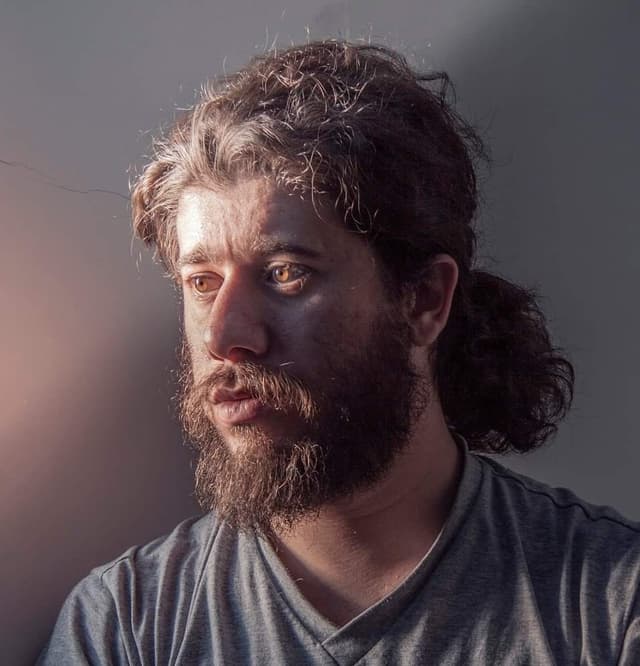
Vafa Almasi (b. 1987, Hoy, Iran) is a painter based in Ankara, Turkey. He holds a BA in Graphic Design from UCNA (2011), an MA in Painting from Hacettepe University (2024), and is currently pursuing a second MA in Ceramics and Glass at Hacettepe. Working in acrylic on canvas, his paintings explore the quiet language of landscape — the open steppe, the weight of sky, the long horizon — distilling vast terrain into intimate, contemplative surfaces where light and silence speak.
Drawing from internalized forms rather than any particular geography, Almasi's work moves between abstraction and realism, resisting the decorative in favor of something more essential. His landscapes are realms for contemplation, intended not to mirror the viewer's personal memory but to dissolve the self into a living, elemental space.
Vafa's "figurative-abstract" paintings leave the boundary between the objective representation of nature and its subjective, memory-based reinterpretation to the audience. Relying on internalized forms and the tradition of landscape painting, the artist deliberately eschews mere representation to confront the viewer with the "remembrance of nature." The progression of the works demonstrates an alternating movement between abstraction and realism, placing the painter in a continuous state of experimentation.
Depicting nature with an "open ending" renders the subsequent trajectory of the canvases unpredictable. The evolution of the works moves toward a type of "formal abstraction" — the simplification and sterilization of natural forms — rather than a philosophical abstraction or one arising from a disillusionment with humanity. This dynamic, reciprocal movement between the objective and the subjective defines the artist's constant state of becoming.
These pieces constitute the painter's initial subjective experiments created from memory, aiming to showcase visual literacy and simplify form to achieve an expressive language. Historically, these paintings share an affinity with the rapid sketches of John Constable (a precursor to Impressionism) in capturing the fleeting moments of nature, as well as a photographic approach to recording transforming landscapes. They also share commonalities with the works of Isaac Levitan; Vafa successfully transforms nature into a "motif" while preserving its living essence, maintaining an indissoluble bond with nature rooted in childhood lived experiences.
As the dimensions of the canvases expand, the delicate boundary between abstraction and the atmosphere of nature undergoes no conversion. Unlike the landscapes of Constable or Levitan, which embody daily life or nationalistic perspectives, Vafa's nature possesses an "eternal-primordial" and archaic quality. The introduction of any human element or man-made artifact would jeopardize the existence and purity of these works, exposing them to a structural contradiction.
These inaccessible landscapes are purely realms for contemplation and intuition, with no intention of blending with the viewer's personal memories. Instead, their objective is to elevate the audience beyond the "self" and dissolve them into a living space. These works serve as an equivalent to our inner existence; an embodiment of Stepan Shipachev's poem:
"Nature, this most bashful one, rises to praise itself through your small eyes."
— Dariush Hosseini, painter and critic